Categories
Uncategorized

Silent Night, Weird Night and a Game of Landmark Laser Tag


Purchase Photo View Nearby Photos
Christmas at City Hall, December 7, 2005. Photograph by Dick Gouldey.

As far as Walt Whitman was concerned, light did right by Philadelphia City Hall. Encountering the building’s unfinished “magnificent proportions” one evening, Whitman wrote of “a majestic and lovely show there in the moonlight—flooded all over, façades, myriad silver-white lines and carv’d heads and mouldings, with the soft dazzle—silent, weird, beautiful…” Foreshadowing Andy Warhol’s quip about fleeting fame, Whitman added: “I know that never when finish’d will that magnificent pile impress one as it impress’d me those fifteen minutes.”

We can only guess if Whitman would have been as impressed by the theatrical holiday lighting of City Hall’s portals in 2005. According to the Philadelphia Inquirer, architectural historian George Thomas recalled Whitman and critiqued the project as “less silent and more weird.” Reporter Amy Rosenberg wondered: “Is it art deco or Victorian? Did the Mummers have something to do with it?” Could it have been “something out of Disney? … People who come to see it often don’t know what to make of it.”

City photographer Dick Gouldey captured the special effects on both east portal (illustrated) and west portal (seen here) in versions of the four, rotating lighting schemes that challenged traditional expectations. Covering all bases, the City also put up a traditional evergreen and strung it with lights. Gouldey photographed that, too.

Six years have come and gone and we’ve not heard calls for more of this brand of landmark lighting. If anything, the public memory of this $300,000 production mounted by the Center City District is fading to black. Blame a preference for traditionalism; blame the recession—we’ve never seen anything like it since. And that seems to be OK.

Not that we haven’t used theatrical lighting on historical buildings. For decades, city planner Ed Bacon had promoted the idea of developing such a project to create sets for public performances. In the 1990s, that idea morphed into Lights of Liberty which has become part of Philly’s repertoire to help tell the story of 1776.

By contrast, the City Hall portal project seemed to be light for light’s sake. Its designers borrowed from the most advanced theater lighting techniques and digital photography, but other than the technology itself, the finished work shared no story; it offered no narrative.

The public’s apparent lack of enthusiasm for the 2005 project begs the question: Can a state-of-the-art “fusion of theatre, artistic programming, theatrical design and lighting,” devoid of narrative also be successful? Or does the public need more than a heady collaboration of international creatives (Artlumiere and Casa Magica) and their “extraordinary new form of expression,” even if they deliver on their promise of visibility “along the entire length of Market Street”? There’s more to success than visibility.

The very same special effects had been used “to create a destination and a sense of place” at Caesar’s Palace in Las Vegas, an Apple Computer store in Paris, and other sites around the world. But Philadelphia’s formula for success is more demanding, more complex. Philadelphia already has a sense of place. What folks here want is fireworks and freedom, the spark and the story. Otherwise, the special effects might be impressive, but they’ll amount to little more than an expensive game of landmark laser tag.

Categories
Snapshots of History

Lawson Sanderson: Early Aviation Pioneer

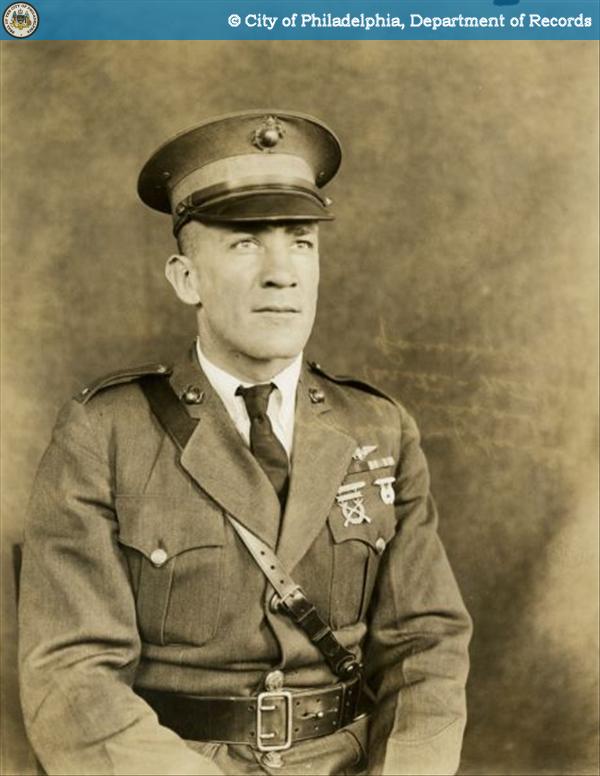
The end of the calendar year offers many opportunities to remember and appreciate the American servicemen and -women who protect our country in the armed forces.  There’s Veteran’s Day, followed closely by the anniversary of the founding of the United States Marine Corps, along with Pearl Harbor Day.  Today, when we take these opportunities to think of our military, we think of one of the most technologically advanced bodies in the world.  While this has been true for a long time, there was an era not so far in the past when pioneers were still experimenting with what we’d now consider basic combat maneuvers as well as creating new forms of machinery and weaponry.  One of those pioneers was Lawson H. “Sandy” Sanderson.  PhillyHistory features a photo (below) of Sanderson in the Sesquicentennial Collection.  While we cannot be sure, Sanderson may have participated in Philadelphia’s Sesquicentennial celebrations as one of the many pilots who put on aviation demonstrations as part of the festivities.

Purchase Photo

Sanderson rose to the rank of Major General, a two-star post, in the Marine Corps and was a skilled, daring aviator.  He was a trailblazer in perfecting a combat technique that would become crucial to modern warfare:  dive-bombing.  In 1919, the United States was involved in a skirmish in Haiti when some Marines were trapped by the rebels they were fighting.  Then-Lieutenant Sanderson was the commander of the 4th Squadron there.  He realized the US forces in Haiti were in need of assistance from the air.

Dive-bombing was just the thing, invented by British forces during World War I, but plagued with problems of inaccuracy.  Pilots were limited by an inability to clearly see their targets and properly aim their munitions.  Aviators had to release their bombs while flying horizontally, using only their rear observers’ directions and best guesses as to where the explosives would land, which Sanderson realized wouldn’t work in the close confines American troops were dealing with in Haiti.

Clearly, new technology needed to be perfected.  Sanderson was just the man for the job.  He undertook several trial-and-error experiments before figuring out a technique that worked.  He improvised a sight by mounting a carbine barrel, lined up with the plane’s long axis, to the windshield of his aircraft, an unarmed training craft, called a Curtiss JN-4 or “Jenny.”  Through his experiments, Sanderson found that dropping his plane’s nose and flying in at a 45° angle, then considered steep, was the most effective course of action.  He understood that the aircraft needed to dive toward the target in order to reduce the amount of time the bomb fell through the air.  The distance a bomb had to fall was highly influential in the accuracy of the hit.  The shorter the distance of the descent, the more precisely the bomb would hit the intended target.  Once Sanderson figured out the ideal angle, he then strapped a bomb in a canvas bag to the belly of his plane and flew into combat to rescue the stranded American forces.  He dropped the ordnance himself from approximately 250 feet and accurately hit his Haitian target, thus single-handedly liberating the trapped US troops.  However, the nearly vertical ascent necessary for recovery from the dive almost caused his aircraft to disintegrate.  Sanderson managed to avert crisis on this occasion, but it would not be the last time he experienced such dangerous flying conditions.

Sanderson’s improvised dive-bombing technique was so effective that other pilots began utilizing his system.  He was then tapped to teach it to other combat forces.  The innovation in dive-bombing that Sanderson came up with greatly enhanced the ability of the US military to stage raids from the air.  Sanderson’s improvement would be pivotal when the US later intervened in Nicaragua.

Undoubtedly, Sanderson was an aviation pioneer.  He was one of a group of several other crack fliers of his time.  This was an era when Americans were fascinated with airplanes and flying, which gave rise to many exciting aviation demonstrations.  One such event was the Pulitzer races, which took place from 1920-1925.  Sanderson was one of the participants in the Pulitzer races.  During this time, he experienced several more near-misses similar to the one he averted in Haiti.

These races were sponsored by Ralph Pulitzer, journalist and the son of Joseph Pulitzer, who established the Pulitzer Prizes.  The contests were a chance for pilots to show off their maneuvering skills and their planes.  Many of the aircraft were cutting-edge or even experimental.  Aviators could exhibit their daring and demonstrate just how fast their planes could fly.  Often, these fliers pushed the limits of their vessels’ abilities, setting new speed records and, occasionally, crashing their aircraft or making emergency landings after pushing them to their limits.  The pilots flew at such high, unheard-of speeds that many reported losing consciousness on turns because their planes weren’t equipped to combat the extreme gravitational forces they were experiencing.  Naturally, passing out in the cockpit led to a few mishaps.  Sanderson was not immune.  He won the prize for best air speed in a 1922 race, but lost another race he nearly won when he ran out of gas.  The race required each pilot to make several laps of a course and then taxi on the water during certain passes.  Sanderson had to drop out a mile from the finish due to his empty fuel tank.  In the next race, in which Sanderson flew what was known as the “Navy Mystery Plane,” his engine failed and Sanderson was forced to drop out in the penultimate lap.  He executed a somewhat controlled crash in a lake and then had to swim back to shore.  In 1923, Sanderson flew in a race in which he crossed the finish line just as his fuel gauge read empty and landed in a haystack.  His top speed during that event was just over 230 miles per hour.  Participating in the races was only a small piece of Sanderson’s remarkable life.

Sanderson spent his career in the Marine Corps and went on to serve in World War II.  He became a part of history when the Japanese government surrendered Wake Island.  Japan used Wake in part to launch the attack on Pearl Harbor.  Some American forces were stationed there, but the Japanese took the island in late December of 1941.  Later, Japan would use Wake Island as a command post and to launch further offenses on Hawaii.  Throughout the war, the US repeatedly attempted to take back Wake Island.  The Japanese finally relinquished Wake to the US on September 7, 1945.  By that time, Sanderson was a Brigadier General, and the official to whom the Japanese surrendered the island.

Sanderson was born on July 22, 1895 in Shelton, WA.  He died on June 11, 1976 in San Diego, CA.  He was 80.  Sanderson Field, an airport in Shelton, WA, formerly called Mason County Airport, was renamed for him in August of 1966.

“Lawson Sanderson: Early Aviation Pioneer” is part of the “Snapshots of History” series that provides background info on select images from the PhillyHistory.org database.

Sources:

1. “Airpower and Restraint in Small Wars,” Aerospace Power Journal, Fall 2001 http://www.airpower.maxwell.af.mil/airchronicles/apj/apj01/fal01/johnson.html

2. “Army Flier Speeds 220 Miles an Hour,” New York Times, October 9, 1922, http://query.nytimes.com/mem/archive-free/pdf?res=F20A15FB345411738DDDA00894D8415B828EF1D3

3. “Dive bomber,” Wikipedia article, http://en.wikipedia.org/wiki/Dive_bomber

4. “Lawson H. Sanderson,” on Early Birds of Aviation, Inc., Ralph Cooper, http://earlyaviators.com/esanders.htm

5. “The Pulitzer Races,” Lieutenant Colonel Robert H. Rankin, USMC, Proceedings Magazine, the US Naval Institute, September 1959, Vol. 85/9/679, http://www.usni.org/magazines/proceedings/1959-09/pulitzer-races-1920-1925

6. “Ralph Pulitzer,” Wikipedia article, http://en.wikipedia.org/wiki/Ralph_Pulitzer

7. “Sanderson Field,” Wikipedia article, http://en.wikipedia.org/wiki/Sanderson_Field

8. “To Hell and Back:  Wake during and after World War II,” Dirk H.R. Spenneman, from Marshalls: Digital Micronesia, http://marshall.csu.edu.au/Marshalls/html/Wake_WWII/Wake_WWII.html

Categories
Uncategorized

The Rise and Fall of Philadelphia’s Schools


Purchase Photo View Nearby Photos
Construction of West Philadelphia High School, 48th and Walnut Streets, April 11, 1912.

When school reformers look at Philadelphia’s situation in 2011, they see too many old and inadequate buildings. Half of the Philadelphia School District’s 257 schools were built before World War II. About one in ten is rated “poor” for condition; more than half only “fair.”

One hundred years ago, there weren’t enough buildings to educate Philadelphia’s 182,637 public school students. Crowded conditions would worsen as elementary school age students, which comprised 93% of the total, moved through the system. And Philadelphia’s population would increase by 300,000 between 1910 and 1920, adding new demand.

Educators here watched with envy as other American cities fixed their overcrowded conditions by investing in new schools. Chicago, for instance, had 33% more students but spent 250% more than Philadelphia on construction. In 1909, not one of a dozen other cities examined had schools as overcrowded as Philadelphia’s, where one-third of the students could only attend school part time for lack of classroom space.

School reform had been long in coming. In 1893, advocates finally overcame opposition and passed child labor laws. Two years after that, the State Legislature passed the compulsory school attendance laws. In 1905, lawmakers instituted the Pennsylvania’s Public School Reorganization Act and in 1911 they granted the Philadelphia School Board the power to raise or borrow funds needed to meet the community’s growing needs.

More than any other year, 1911 was special in the history of Philadelphia public education. Educators had the vision, understood the need and now had the power to implement reform and stake out an enhanced significance for schools. There’s “a new conception of the functions of the public school,” declared District President Henry R. Edmunds. “There was a time when the public school was regarded as being simply a place for scholastic instruction. … To-day, a multitude of interests are being cared for by the public school system which no one dreamed of…medical inspection, vocational training, music, physical training, social centers, open air classes, evening lectures to adults, school gardens and summer playgrounds. … There is a growing tendency for the community to regard the school as the center of much of its social life.” Of course, Edmunds added, “these things cannot be done without money, and that ultimately it rests with the people to pay the bill.”

And so, the people of Philadelphia paid for an enlarged and improved public school system. A remarkable period of construction, already underway, continued with a new head of steam. Ground breakings for scores of larger schools in dozens of neighborhoods, including this tract at 48th and Walnut Streets where West Philadelphia High School soon rose, and resulted in much-needed facilities. Never before had Philadelphians seen school construction on this scale. (PhillyHistory.org offers up more than 3,100 photographs documenting new construction between 1905 and 1915.)


Purchase Photo View Nearby Photos
Construction Kenderton School, 15th and Ontario Streets, November 25th, 1907.

A century later, the space issue had flipped. Last year, the School District closed West Philadelphia High School and today it’s slated to be sold. The call for reform is as sharp as ever. The current number of students in District schools is 152,411 and is expected to decline by another 6,000 before the end of this decade. One-third of our classroom seats are empty. Scores of schools once were thought to be solutions are now the problems.

Recently, the Philadelphia School Board issued recommendations to “reduce the overall capacity of the District…through closure and consolidations… and aggressively dispose of surplus properties.” The first steps, over the next two years, would close nine schools including Sheppard Elementary; E.M. Stanton Elementary; Philadelphia High School For Business (originally built as Helen Fleisher Vocational School); and Levering Elementary. These closures would reduce classroom seats by 14,465, or 20%.

It’s a matter of supply and demand. In the 21st century we are bound to undo a significant amount of what the 20th century left behind. Future recommendations will doubtless result in additional closures. (The 98-year-old Horace Furness School, for instance, not on the current list, is now more than half empty.)

But it’s also a matter of debate and discussion. Closures evoke reaction from every quarter: reformers, bureaucrats, philanthropists, neighborhood activists, teachers, parents, students, and even preservationists, demonstrating that it’s not fast—or easy—to intelligently shrink a city.

[Note: Schedule of School District’s Facilities Master Plan Community Meetings.]

Categories
Uncategorized

Back to Basics at Logan Square


Purchase Photo View Nearby Photos
Parkway from Bell Telephone Building – 17th and Arch Streets, February 7, 1919.

No matter how welcomed and honored they may be, guests just don’t get to call the shots. It’s a basic law of hospitality. About a century ago, when planners exercised “excellent ruthlessness” sacrificing an entire rowhouse neighborhood and leafy park at Logan Square to welcome the automobile into the city, folks hoped for the best in what would eventually become a difficult, if not doomed relationship.

OK, it’s true: driving the Benjamin Franklin Parkway makes for one heck of an entrance to a city, maybe any city anywhere.  Space collapses with a touch of the gas pedal.  City Hall rises up as the Art Museum fades in the rear-view mirror. Never before or since had a city and a machine found such amicable terms. Philadelphia embraced the automobile, as Ed Bacon used to say, as “an honored guest.”  But where is it written that the city also had to turn over naming rights to the petroleum philistine?

Logan Square has been victimized, again and again, by the automobile. To create a sweeping vista, an axis connecting City Hall and Fairmount, to enable a unique urban driving experience on it, Parkway designer Jacques Gréber expanded the Square westward to 20th Street, doing away with one street, West Logan Square, and demolishing a block of fifty-five houses.  Then, with a landscaper’s sleight-of-hand, Gréber carved out an off-center circle and created on it the illusion of centrality with a giant obelisk.

The obelisk gave way to the eye-catching Swann Memorial Fountain by architect Wilson Eyre and sculptor Alexander Stirling Calder. But not everyone was taken in. As Jane Jacobs put it in The Death and Life of Great American Cities, the square “has been whittled to a small traffic island” adorned by a “great soaring fountain” that’s mostly “an elegant amenity for those speeding by.”  Pedestrian visitors knew as well, from both reality and name, they were the guests here, on a purpose-built traffic island, maybe the most glorified one in history.

And if a multi-lane traffic circle wasn’t harsh reality enough, in the third quarter of the 20th century, Logan Square’s entire northern side was given over to a sunken expressway.  Long before then, the name change from Logan Square to Logan Circle had driven home the fact that this place no longer existed in the spirit of its 17th-century designers. Logan Circle was now about its capacity to funnel automobiles into the city.

“Is all the asphalt around Logan Circle really necessary?” asks the Project for Public Spaces, which included Logan Circle in its Great Public Places “Hall of Shame.” PPS suggests how to fix the place, and folks have begun to pay attention.  But those changes will cost us.

Why wait?  We can take a first, important step in the journey to recognize and reclaim the authenticity at hand. We have here a great square, albeit one with a circle in it.  The place should be named for what it offers pedestrians, not how it yields to the automobile.   A name change, and the change of mind that will accompany it, will cost nothing.  It’s time, once again, to call a square a square.

Categories
Uncategorized

The Parkway’s Tipping Point: a Millionaire, a Mayor and a Model

The Parkway Model Looking [North]West, Mayor’s Reception Room, City Hall. May 1911. (PhillyHistory.org)

Imagine John Reyburn’s shock when he heard the massive Parkway project was headedliterally – in the wrong direction. Demolition of the first of 1,300 buildings had been underway for two months when Reyburn, Philadelphia’s brand new mayor in April 1907, learned that the swath being cut through the northwest quadrant of Center City was off course.

Reyburn became convinced of the City’s profound mistake days after his inauguration in a meeting with streetcar magnate P.A.B. Widener, who summoned him to the palatial Lynnewood Hall in Elkins Park. One of the nation’s richest and most voracious art collectors, Widener had been trying for more than a decade to get Philadelphians interested in his vision for a new art museum. Why should the Parkway, which started out at foot of the monumental City Hall, come to a distinctly unceremonious end in the park when it could terminate with a glorious new museum, set high on Fairmount?

Reyburn agreed with Widener. And he immediately took it upon himself to adjust the Parkway’s course. Correct “the present line of the Parkway, “he wrote in his first annual address, and continue “the removal of buildings on the new line. … I want this improvement to be the magnificent work that it ought to be.” The Parkway “is an opportunity that no other City in the United States can boast.”

But moving the Parkway’s axis would add $2 million to an already complicated and expensive project. How could Reyburn convince City Council, business leaders and the public that they had gotten off on the wrong foot and the fix would be worth the cost?

First there was compromise. The Parkway’s axis would be angled to the south of its former line, but planners would also artificially extend Fairmount itself to the north.

Then there was a rethinking of the far end of the Parkway by the city’s design establishment. Architect Charles L. Borie took the idea of placing the Philadelphia Museum of Art on Fairmount and went even further. He envisioned a grand plaza surrounded by a cluster of institutions for art and art education. As Borie’s partner, Clarence Zantzinger put it, “the opportunity is…unique in any city in the world.” The Parkway had evolved into something more than an ambitious boulevard connecting park and city. Now it was becoming a sophisticated, civic and cultural solution for the new century.

Reyburn continued to build support by appointing a group of bankers and businessmen, who served, along with city officials, on a new “Comprehensive Plans Committee.” Their work was timed to conclude before a national conference on city planning convened in Philadelphia.

In fact, Philadelphia’s commitment to planning had made the city the preferred location for its Third Annual City Planning Conference in May 1911. Frederick Law Olmstead, Jr., who headed up the conference the year before, said as much. In terms of city planning, Olmstead told Reyburn, “your city is the farthest advanced in the country.”

Detail of Parkway Model in City Hall, 1911. (Click image for uncropped version.)

Reyburn proudly hosted the 200 professionals who came from all over the United States. But what was he doing to build support among the taxpaying, voting citizens of Philadelphia? Journalist and planning theorist Charles Mulford Robinson, the man who popularized The City Beautiful Movement, happily noted Reyburn’s tactic designed to build public support. The conference, wrote Robinson, “was more than its title suggests or promised.” The mayor used it as an excuse to mount the “first municipal planning exhibition in America.” And the Parkway would be its focus.

For this exhibition, the Department of Public Works presented new drawings of the re-envisioned Parkway and they built a thirty-foot model that resided for a full month in the Mayor’s Reception Room. The public showed up in droves; a reported 20,000 came the first day. They filed past displays lining the corridors of City Hall to see the model, the exhibition’s pièce de résistance.

So what did Philadelphia taxpayers, those who would foot the bill for this largely expanded and hugely expensive project, conclude? The idea of the Parkway, which had first been proposed forty long years before as a way to the park, now looked like something to be proud of, a public avenue that would come to redefine Philadelphia.

For more information: David Brownlee, Building the City Beautiful: The Benjamin Franklin Parkway and the Philadelphia Museum of Art. (Philadelphia Museum of Art, 1989).

Categories
Uncategorized

Yo, Alice: We still have the one that got away. (It’s around here somewhere.)


Purchase Photo View Nearby Photos The Pennsylvania Academy of the Fine Arts, Broad and Cherry Streets, 1925.

It’s not every day, or even every decade, that a major museum of American art opens for business. In big cities, it’s a once-or-twice-a-century kind of thing. This week, Alice Walton’s Crystal Bridges Museum of American Art opens in Bentonville Arkansas “to celebrate the American spirit.” Even though the place, built on the Wal-Mart fortune, is more than 1,200 miles away from Philadelphia, we can hear the hoopla. And it might have stung our ears, had things turned out a bit differently.

By coincidence, five years ago today was the start of the most recent Thomas Eakins’ Gross Clinic saga. What might have been the beginning of the end of Philadelphia’s stewardship of a painting long considered “the holy grail of American painting” started with an announcement that Thomas Jefferson University would sell the painting to Crystal Bridges and the National Gallery of Art in Washington, DC for the record-breaking price of $68 million. “This is the most important sale of a 19th-century American painting ever,” boasted the president of Christie’s Americas, which crafted the deal. Washingtonians considered landing this picture inside the Beltway on Bentonville’s dime as a big win-win.

But Philadelphians saw the situation differently. And the agreement of sale contained a small clause that, as it turned out, became a potent loophole. If locals wanted the painting they had forty-five days to match the price. Raising $1,511,111 a day, day after day for a month and a half? Sounds impossible for these recessionary times, but in the flush holiday shopping season of 2006, 3,400 Philadelphians reached deeply into their pockets and, with significant help of major philanthropy, a humongous bank loan and at least one case of controversial deaccessioning, the Eakins was ours to keep. Alice Walton would just have to make do with less.

So when they cut the ribbon in Arkansas this Veterans Day, Dr. Gross (who Eakins depicted teaching the surgical technique he innovated to save lives and limbs of thousands of Civil War soldiers) will not be in attendance. So where is the painting this Veteran’s Day, this fifth year anniversary of its near departure?

Searching for Dr. Gross, we look to the Philadelphia Museum of Art website, and see one page that steers us to “Colket Gallery 151.” But he’s not there.  Another PMA webpage tells us he’s “currently not on view.” Hmmm, really? Not on view? The Academy’s website doesn’t give us a location, either.

But visitors to the museum at Broad and Cherry will find the painting hanging in Frank Furness’ central rotunda, which as it happens, was completed about the same time Eakins was painting his masterpiece.  After sixty eight million dollars and five years, you’d think we’d be more inclined to coordinate, communicate and, especially this week, to celebrate.

Could it be that we’ve begun to slip back into that old, familiar, Philadelphia complacency?  Now that’s a scary thought.

Categories
Uncategorized

Cracking the Sculptural Code in City Hall Courtyard


Purchase Photo View Nearby Photos City Hall Courtyard During Subway Construction, November 16, 1915, N. M. Rolston, Photographer.

Smack dab in the center of Philadelphia is a building with scads of sculpture and one persistent mystery. Philadelphia City Hall is encrusted with no less than 250 marble figures, heads, allegories, principles and attributes by Alexander Milne Calder and his team. It’s been called “the most ambitious sculptural decoration of any public building in the United States.” Yet, historians have always been a bit perplexed. City Hall is without “a coherent plan for the iconography.” All that marble and no meaning. How frustrating.

We’ve long suspected there are hidden clues. The building’s exterior and tower offer a cacophony of sculptural meaning. But when it comes to City Hall’s courtyard there are no figures, nothing to interpret. All we see there are the nearly plain white marble surfaces. In the courtyard, the world’s largest and most complex sculptural program comes to a dead stop.

How could this be? Why did these prolific Philadelphians, architect John McArthur, sculptor Calder and building commissioner Samuel Perkins opt for utter silence in City Hall courtyard? Maybe we’ve been asking the wrong questions, placing emphasis on the wrong sculptural syllable. Maybe it’s more about what isn’t there at City Hall than what is there.

McArthur, Calder and Perkins didn’t run out of ideas when they came to City Hall’s courtyard. Instead, what they embraced in this heart of the building (the heart of the city!) is the opportunity to express a startlingly modern idea. It’s a sculptural program turned inside out.

We the people complete the sculptural program of City Hall. That’s right. City Hall courtyard is an interactive, do-it-yourself civic sculpture, maybe the only of its kind. By being there, we literally bring City Hall to life. The sculptural program isn’t about sculpture, or historicism, or representations of any kind; it’s about the living, breathing here and now. City Hall comes alive in the same way a Quaker Meeting does; it’s powered by people.

Still not convinced? Stand in the center of the courtyard and look up. There, 510 feet above the sidewalk, more than 300 years in the past, stands the founder himself. We can’t see him beyond the beak of a giant eagle, but we know he’s there; we feel his presence. Look down, there’s the very center of the city he dreamed up. But it’s not Penn’s city anymore, it’s ours. The building is a timeline starting in the 1680s and ending, literally for the moment, anyway, with us in City Hall courtyard.

Standing in the center and searching for more confirmation, we look through the four portals and see the city come together at the spot where we stand, the center of the compass. Then we walk north, beneath the tower. There’s bound to be a hint of meaning there. And so there is: in the chamber criticized in 1876 as a “chamber of horrors” we see the carved heads of dominant animals from the four corners of the earth: bull, bear, tiger and elephant. They focus inward toward four robust, perfectly polished red granite columns. Atop of them are human figures, also from around the world. They are our symbolic stand ins, arms locked and straining, bearing the burden of the tower, the history that is so high above and so long ago.

But these figures are only symbolic. Standing there, witnessing and understanding, we participate in the meaning of the place, we join the continuum of Philadelphia. It’s all, as Walt Whitman once famously put it: “a majestic and lovely show—silent, weird, beautiful.”

Categories
Uncategorized

Philadelphia’s Scariest Halloween Is Yet To Come


Purchase Photo View Nearby Photos
Eastern State Penitentiary, passage connecting cellblock 4 and the central hub,
before stabilization, July 22, 2002. Photograph by Dick Gouldey.

It used to be Halloween was for kids: all fun and screams. Now it’s into the serious stuff of big business. Halloween’s about the bottom line. And at historic sites, it’s also about another line, the one that used to be a firewall between non-profit organizations and for-profit activity. In recent times, that line has gotten very squiggly.

Many historic sites subscribe to the principle that if it’s October, it’s OK to cross that line. Come November, it’s OK to cross back again—just in time to send out those end-of-the year, tax-deductable gift appeals that stuff your mailbox.

For better and for worse, Philadelphia’s biggest player of the Halloween scare-and-switch fundraising shtick is Eastern State Penitentiary. Not long after 1994, when the Pennsylvania Prison Society opened the 1820s landmark for its first season of interpretative tours, the Halloween seed was planted and nourished. Folks at Eastern State didn’t invent October magic, but they certainly reinvented it. Over the last two decades, Eastern State informs us, they’ve become “the nation’s premier haunted attraction, head and shoulders above the hay rides and other haunted houses out there. Our goal is to make you scared. Really scared.”

A couple of years ago, Haunted Attraction Magazine anointed Eastern State among the nation’s top three “must-see haunted houses” (it’s currently number 19.) Each year, the stakes grow greater and the slope gets more slippery.

Eastern State is hardly alone. Television’s Ghost Hunters (on the Syfy channel) launched its fifth season with a story of violence and death at the Betsy Ross House—from 1980. (Ghost Hunters’ current season exploits the 20th century horrors of overcrowded conditions at the closed Pennhurst State School and Hospital in Chester County.) Back in town, the City Tavern gets into the act with tales of a former waiter who died in a bar fight. Fort Mifflin brags of battlefield ghost Elizabeth Pratt, aka “The Screaming Woman.” There’s “The Spirits of ’76 Ghost Tour.” Germantown has its “Ghosts of the Great Road.”

As the best in its class, Eastern State gets to charge as much as $30 per ticket, half of which goes to their bottom line. Then there’s a cut of parking sales and the “Fright and a Bite” dinner packages with nearby restaurants. Souvenirs stocked at the “nighttime haunted house store” include “Terror Behind the Walls” tee-shirts, shot glasses and boxer shorts (black only). Visitors can buy plush, miniature versions of “Frank the Gargoyle,” or the latest edition of Haunted Attraction Magazine, “the premier publication of the dark amusement industry.”

In 2009, according to documents filed with the IRS, Eastern State collected nearly $1.4 million from the fundraising event called Halloween. Where does that money go? A fire suppression system, stabilization of cellblocks, a tower cam. It’s no trick. Year after year, the bulk of Eastern State’s budget comes from Halloween treats.

What’s terrifying is that Eastern State has become deeply addicted to this funding scenario. And it summons up another frightening question: What is the site’s responsibility to the thousands of visitors lined up for a not-so-cheap thrill? It seems that during the Halloween fright-fest, Eastern State’s mission goes on hiatus, at least the part of it that claims to explain and interpret a “complex history; to place current issues of corrections and justice in an historical framework; and to provide a public forum where these issues are discussed.” These issues, their mission statement adds, are “of central importance to our nation.” Even in October.

Categories
Events and People Snapshots of History

Schuykill River Floods, March 1902


Purchase Photo View Nearby Photos
Baltimore and Ohio Railroad Station During Flood – Flooded Train Shed.

With the recent record levels of rainfall in Philadelphia, images such as these two photos have unfortunately become a familiar sight in our area. Though most Philadelphians do not remember another time when there seemed to be so much water everywhere, the city is actually no stranger to disastrous flooding.

The combination of a particular harsh winter that led to above-average amounts of melting snow plus the occurrence of a severe rainstorm on the night of February 28, 1902 led to so much water flowing into the Schuylkill River that it “broadened to twice its normal width.” As the sun rose on the morning of March 1, people were able to see just how bad the overnight devastation was. The sight of the swollen river full of debris set against a perfect blue-sky morning was one of such “ruinous grandeur” that it brought “thousands of spectators to bridges and points of vantage.”


Purchase Photo View Nearby Photos
Baltimore and Ohio Railroad Station During Flood – Flooded Waiting Room.

The two photos here show the Baltimore & Ohio Railroad Station located on the east bank of the Schuylkill at 24th and Chestnut Streets. Designed by Frank Furness and opened in 1888, the station was constructed so that the main entrance was level with the Chestnut Street Bridge with passenger waiting areas and tracks 30 feet below. While this design allowed for better flow of passengers by providing for both upper and lower waiting areas, it also meant that the lower areas were particularly vulnerable to flooding. On the morning of March 1, it was reported that the lower levels of the station had taken in five feet of water. By the afternoon, the level was reported to have lowered to a foot and a half, which would appear to be when the photos were taken. B&O had suspended service the night before as water slowly crept into the station, but by the next day the flooding had wreaked havoc on other rail lines as well. Both the Pennsylvania and Philadelphia & Reading Railroads also suspended service.


It took many months and millions of dollars for Philadelphia to recover from the flood. The Baltimore & Ohio Railroad reopened the 24th Street Station and used it continuously until April 1956 when B&O suspended all passenger service north of Baltimore. The station was demolished in 1963 and the site is now home to a luxury high-rise apartment building

Sources:

“Schuylkill is a Raging Torrent.” The Philadelphia Inquirer, March 1, 1902.

“Swollen Schuylkill Bursts Its Bounds, Throttling Traffic, Damaging Property.” The Philadelphia Inquirer, March 2, 1902.

Categories
Uncategorized

Short Shrift for the Long Room at Independence Hall


Purchase Photo View Nearby Photos
The Long Room, Second Floor at Independence Hall, January 8, 1924. Warren A. McCullough, Photographer.

Charles Willson Peale knew an opportunity when he saw it. Two centuries later, what do we see?

In 1802, the 100-foot “Long Room” at the State House (aka Independence Hall) became available when the Pennsylvania’s legislature left for Lancaster. The acquisitive and talented Charles Willson Peale had installed his museum (and his family) in the adjacent Philosophical Hall eight years before. Now, his expanded collections had that space bursting at the seams. The spacious Long Room beckoned. Peale couldn’t imagine a better place for the United States to open its first “great national museum.”

Peale negotiated a deal and soon filled the State House with everything American, and then some. Opposite the windows in the Long Room, he stacked four rows of cases with more than 700 American birds. Peale and his artist sons painted the inside of each case with backgrounds to replicate their natural habitats and arranged them according to the Linnaean system. Above, Peale installed two rows of a newer, man-made order: America’s “Illustrious Personages painted from life” by Peale and son Rembrandt. The Peales did it all: art, taxidermy, presentation and interpretation.

Both “the unwise and the learned” got their money’s worth here. For the twenty-five cent admission fee visitors gained access to the Long Room, the Marine Room and the Quadruped Room, which displayed 90 mammals, including a stuffed grizzly bear and buffalo. To see Peale’s pièce de résistance, his mastodon, they’d pay an additional fifty cents. Peale excavated and presented the “Great American Incognitum” specifically to counter Old World claims that America didn’t have as robust a natural history as did Europe. He proved the Europeans wrong presenting a twelve-by-nineteen-foot mastodon—a fossilized skeleton large enough to serve a banquet underneath its rib cage.

Opposite the wall of birds and Founding Fathers were thousands of fossils, shells, rocks, minerals and insects. (See Titian Ramsay Peale’s watercolor from 1822.) For exhibits too small to see with the naked eye, the museum offered microscopes. To set the mood for enlightenment it provided live organ music. Visitors left with souvenir silhouettes cut by Moses Williams, Peale’s former slave. For years, Williams operated the newly-invented physiognotrace in the Long Room, cutting miniature profiles for anyone who wanted them. In 1803 alone, Peale claimed Williams made 8,800 of them.

Not everyone thought this the highest and best use of a place increasingly considered a “sacred shrine.” Social reformer Fanny Wright “was a little offended to find stuffed birds and beasts, and mammoth skeletons filling the place of senators and sages.” She suggested something “in better taste…a library, instead of a museum of natural curiosities, or a mausoleum of dead monsters.”


Purchase Photo View Nearby Photos
Charles Willson Peale, “The Artist in His Museum,” 1822.

Peale’s famous painting from 1822, The Artist in His Museum, (illustrated and at the Pennsylvania Academy of the Fine Arts here), confidently responded to the naysayers, which included members of Congress who failed to see it for what it was: a serious and creative venture, a unique and uniquely American institution. Repeatedly, Peale’s pleas for support fell on deaf ears.

The museum remained open after Peale’s death in 1827, but the writing was on the wall: it would eventually fail. Peale’s collections would be dismantled and disbanded. The building, as Charlene Mires put it, would soon become “a workshop of memory for elite Philadelphians, who stripped away most material reminders of the building’s nineteenth-century history.”

Today, what Peale imagined and accomplished for his time in the Long Room is largely forgotten. And his success begs the question: Can a place be so overwhelmed by a rich but narrow interpretation of the past that it forever loses its ability to connect with the present? Is there any hope for new life in the Long Room? Peale saw its potential and acted on it. In the 19th-century, he created a patriotic place, but one infused with cultural value and educational, social and practical significance.

What can we imagine for the Long Room in the 21st century? Surely there’s untapped value for us, too, in this rich and resonant place.