
Philadelphia’s massive and ultimately successful songfest of 1912 drove home the city’s need for a gigantic venue to house all manner of gatherings. Everyone knew the temporary wooden structure off the beaten track at Broad and Allegheny was neither safe nor sufficient. Plans for a Parkway were evolving more than three miles to the south in Center City. Perhaps that would be the logical place for great gatherings?
A variety of competing proposals gained momentum. The businessmen of Walnut Street backed the idea of a convention hall spanning piers over the Schuylkill river from Market to Chestnut streets. Though conveniently close to Center City, this solution failed to earn the support of Mayor John Reyburn, who turned up his nose at the river location, calling it an “open sewer.”
With less than a year remaining in his term, Reyburn convened a committee to guide the decision as to which location best suited the need. The committee enthusiastically backed a site deep in East Fairmount Park, at the heart of a proposed, 46-acre event complex. Architect John T. Windrim landed the assignment and quickly produced a set of drawings and maps.
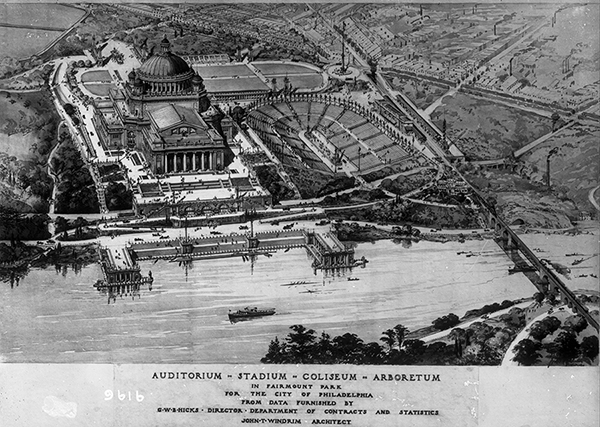
“The report of the mayor’s committee on plans for a great convention hall . . . quieted much of the opposition,” editorialized the Inquirer, which recommended the park site and urged construction not only of a “vast hall [with] seating capacity sufficient for all requirements,” but also a stadium, “the like of which does not exist in America” and “a recreation field with every facility for aeroplane and athletic meets.” A grand vision for an even grander entrance to the park expressing a new and expanded “greene country towne.”
The most concerning objection to the site was access. But the committee showed “there will be no serious difficulty in that regard, [that the] central section of the city [could] be accommodated by frequent trains from both the Pennsylvania and Reading terminals.” Passengers between New York and Washington, D.C. would grow jealous of Philadelphia’s new capabilities. “Every passenger over the Pennsylvania [Railroad] from or to New York must be impressed with the magnificent proportions of buildings and grounds because they will loom up before him and prove a constant advertisement of what Philadelphia can do when she really makes up her mind to do a thing.“
When completed, this new convention hall complex “would practically be the northwestern ending of [the] thoroughfare known as the Parkway,” which would not conclude at Fairmount and the Art Museum, but beyond, reaching deep into the park with its array of destinations and amenities.
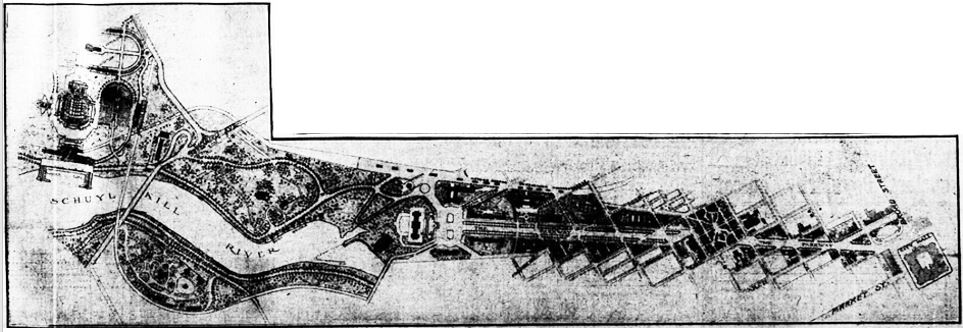
This extension would nearly double the Parkway’s size, adjoining the existing Philadelphia Zoological Gardens and adding an Arboretum, a Colosseum and a Stadium complete with a ¾ mile racing track, in addition to parking for automobiles and, topping it all off, an airstrip.
Construction “is proposed to start work within a month” promised a hopeful Inquirer. “Build!” declared the editorial. And why not, agreed many supportive citizens. But if the idea to double the reach of the Parkway proved popular – its increased expense determined that Philadelphia could not afford such a Parkway, with all the desired bells and whistles.
The next (though hardly final) iteration for a grand auditorum would be more modest, occupying the soon-to-be-demolished block of 2100 Callowhill Street, halfway between Logan Circle and Fairmount. The Art Museum would cap that shorter, still grand, and significantly more affordable, vision for the Parkway.
(Sources: from The Philadelphia Inquirer: “That Convention Hall,” Editorial 11- 15- 1910; “Convention Hall to be Built in Park; Will Break Ground Within a Month,” 2–26–1911; “Build the Convention Hall,” Editorial 2–28–1911; “Park Commission Adopts plans for Convention Hall,” 8-10-1911.)
2 replies on “Grand Vision for an Extended Parkway”
I’m a life-long Philadelphian who now makes my home in St. Louis, and this article invites a comparison between what Philadelphia did after the 1876 World’s Fair, and what St. Louis did after the 1904 World’s Fair. Forest Park — the site of the 1904 Fair — now includes within its borders the Art Museum, Science Museum, History Museum, St. Louis Zoo, the “Muni” outdoor theater, and more.
Interesting that you would be reminded of the 1904 St Louis World’s Fair, since what ended up as the Wanamaker Organ was originally designed and crafted for that grand fair.