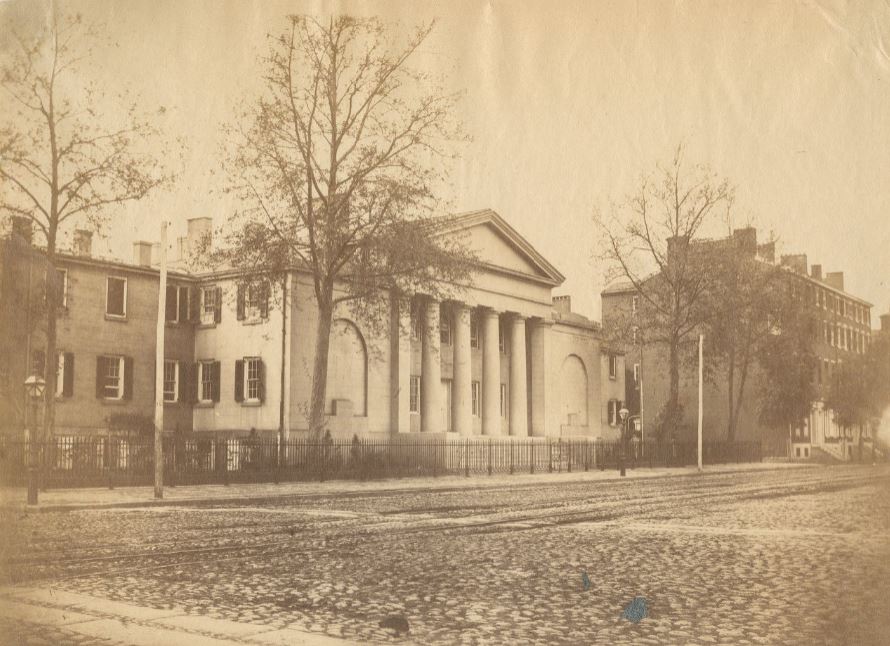
Photographer James E. McClees recast the image of Philadelphia in the 1850s. He focused on low hanging architectural fruit – the institutional structures lining Broad Street. McClees was the first photographer to attempt such a challenging feat. And no wonder, the new technology was awkward and inconvenient, requiring McClees to leave the ease and comfort of his Chestnut Street studio with his large format (9-by-12-inch) camera, a clunky wooden tripod, cased glass negatives slathered with a sticky, noxious emulsion of light-sensitive collodion. Starting as far north as Broad and Green Streets, McClees captured Central High School’s new building. Then southward, where he added the recently-erected the Odd Fellow’s Hall and Spring Garden Institute. In all, McClees traipsed the length of Broad Street for a mile and a quarter photographing the places that were redefining Philadelphia as a thriving 19th-century metropolis. The array included a museum (the Academy of Natural Sciences), a hotel (La Pierre House), an opera house (the Academy of Music), a handful of churches (here and here) and a banker’s mansion too prominent to exclude (the home of James Dundas). Nearly all, save one, had recently opened its doors. And that exception, at the southern most point of this architectural parade, was architect John Haviland’s Pennsylvania School for the Deaf and Dumb (as it was originally named). That structure, completed in the mid-1820s, holds the distinction of being the first institutional structure to grace Broad Street. And today, that building and the Academy of Music are the sole survivors along this civic, cultural boulevard.
McClees’ depiction of the city facilitated an updated interpretation of Philadelphia as a robust, evolving urban response to the question: How would this grided city adapt to the evolving architectural styles and institutional trends after a half-century of growth and transformation? One thing everyone knew for certain: William Russell Birch’s charming, illustrated coffee-table book of 1800, Birch’s Views of Philadelphia, was woefully out of date.
What would take it’s place again as the 19th-century drew to a close, or again and again through the rest of the 20th century and into the 21st?
Today, we learn the fate of Haviland’s vintage asylum which had, in the 20th century, been re-purposed as University of the Arts, will be repurposed again. (In mid-2024 the University of the Arts announced its own demise.)
What will become of this survivor of McClees’ Philadelphia, this national historic landmark at Broad and Pine?
And another, even more challenging question: what is a city without a proud public avenue lined with thriving cultural institutions?
To help inspire this unknown future, we turn to Neil Gaiman’s commencement speech of May 2012. “Make Good Art” was delivered to the graduates of the University of the Arts. Here’s the transcript and the video. Ironic and unfortunate, now that we know what followed, but perhaps helpful at a time when imagination fails.